Feeds:
Posts
Comments

For a L’Eroica participant, spring is the time that alerts the senses to the open road and alerts the mind to the realization that training must begin now. Inspiration in these cold, dark months can

Book Cover, Spring Classics

be found in the sepia toned photos and online videos of previous rides. Another boost awaits us, though, and that’s the tonic of the beginning of the racing season in Europe, beautifully detailed in “The Spring Classics: Cycling’ Greatest One-Day Races.” from Velopress.

Just before this sumptuous bit of coffee table bike porn was released, I found an out of print book on a subject in sport that rises above most others for me: baseball. George Will’s “Men at Work” is an exploration of the important efforts made by several different baseball “workers.” It was auspicious that this book, which I read when it was released 20 years ago, would show up so close to the cycling book. 

I won’t try to draw parallels between the two volumes except for the fervor that both sports engender on opposite sides of the Atlantic. As with the excitement that accompanies spring training so it is with spring racing. 

Most of us know Paris-Roubaix and see it as the jewel in the crown of spring bicycle battles. In some ways, Paris-Roubaix is the only spring race that many on this side of the Atlantic can identify. The Tour de France occupies a similar position in American minds. Paris-Roubaix’s difficult conditions on the pave, the notoriously brutal weather, the distances and the agony of the riders all make for a compelling narrative and drama. But, many other spring races dominate the schedule, which began last weekend with the seminal Milan-San Remo. 

Readers who are most familiar with the sights of carbon fiber bikes ridden by highly trained athletes with radio earbuds fixed and phalanxes of domestiques pulling them along will enjoy seeing working class men pushing single speed bikes over the cobblestones and muddy paths that are the origin of today’s spring races. The copy matches the photography well. By that, I am confirming that this is foremost a picture book, with just enough historical perspective and race reporting to make it more than a gauzy retreat into nostalgia. And, sufficient space is given to current racers to insure that the book, and the races, are relevant to today’s reader. 

So, why review it here, in a blog about L’Eroica, a casual tour in the fall in Italy? Because, the focus of the book is really the tradition of the spring races, where fairly ordinary men, looking for a bit of money and recognition, rode the existing roads and cart paths to a heroic end. L’Eroica’s focus on the old roads and old bicycles, and by association old riders, is consistent with the conditions of the spring races.

When my friends and I started riding bicycles together as adults, we became almost as interested in maintaining our bikes as riding them. We strove to keep races and cones polished to a mirror finish. We exalted in clean chains and shiny seat stems. We labored to be sure that hubs rotated effortlessly, maintaining the delicate balance between loose cones and frictionless tolerances.

Pedals awaiting assembly

Campagnolo Nuovo Record Pedal

We would overhaul our bicycles for nearly any reason. Just completed a long ride? Better check the bottom bracket. Returned home in a sudden downpour? Break down the hubs and repack the bearings. We learned these simple mechanical adjustments and procedures through some guidance from others and trial and error. There was one task, though, that we would delay until the inevitable long ride in pouring rain occurred, and often not then: overhauling pedals.

Our bicycling experiences, on the road and with wrenches, occurred in that time when all bearings were loose and most problems could be cured with a few wrenches. The late ’70’s witnessed the rise of sealed and cartridge bearings, but certainly not under the Campagnolo banner, the place where we were hanging out. Even knockoffs of Campy components stayed true to the free bearing pledge.

That’s fine and it makes for easy maintenance until you get to the pedals. The pedals required a deftness with assembly and tuning that defied the simplicity we experienced with hubs or bottom brackets. One pedal would have 20-24 loose, small ball bearings and sometimes not equally distributed from the crank arm side to the outside. Achieving a smooth, near-frictionless spin on the pedal seemed to take forever.
So, we figured we’d let the pedals go until they had been beaten by all of the elements to the point of no return. That may have been why, when I first assembled the Moseman, it did not have Campy pedals. Why put all that money into something I planned to ignore?

The Moseman today is a hybrid or a Frankenstein. Speedplay X-1 or some other fast sounding product name adorn the crank arms. For L’Eroica, those must be set aside and my choice was to find a good, though not perfect, set of Campy pedals. After several eBay searches and purchases, I found them. I settled on Nuovo Record just because they had a certain style that I liked. And, I believed I could make them turn just like Super Record pedals because of all of those years working on my own bicycles.

If the Flickr Photostream could talk, it would tell you that the time between the first few shots of the assembly until the last shots of the finished goods was about three (3) hours. I don’t think I can expect any offers from any racing teams taking that much time to put 48 bearings back in place. During the process, I managed to spill half the bearings, crawling on my hands and knees to recover the one last bearing that would make the set. And, just like a beginner, I managed to put the left spindle in the right hand cage and vice versa, requiring a complete disassembly and reassembly. But, they are done and soon, the Moseman will sport an age-appropriate set of pedals.

Pay close attention here to the pace of this race. It will be leagues beyond what the L’Eroica riders will be doing. At least this L’Eroica rider. This recently concluded race, won by Phillipe Gilbert, is over many if not all of the roads we will be riding this fall. There are dozens of You Tube videos of the race. This is just a brief highlight. Perhaps if this had been organized a century ago, it would stand in the same realm as Paris Roubaix.

At the Patron’s Table

The Patron

It’s one thing to have a good friend who wants to sponsor your hobby interests with moral support. It’s quite another when he opens up his kitchen to offer you and your colleagues lunch. With Michael, it’s no surprise.

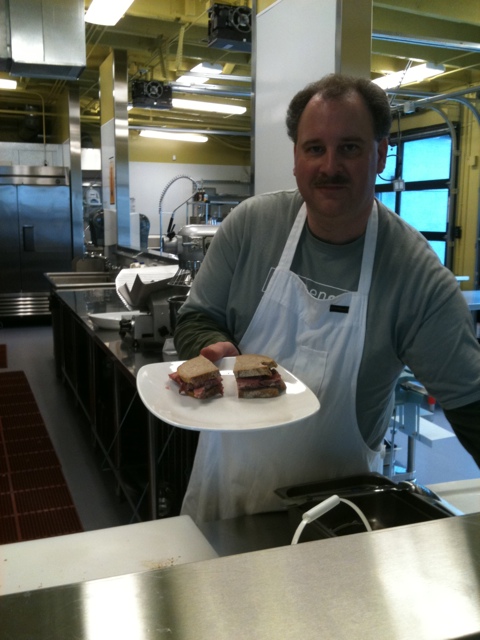
The dish at today’s training table, corned beef. Made right here, of course, by the Patron.
My office mates and I headed down to “Cru Central” for an excellent New York-style corned beef on rye sandwich, washed down with cream soda. My colleagues were treated to some Argyle bubbles, courtesy of one of Michael’s clients.
Guess this means an extra set of intervals tomorrow morning . . .

Waking up, sore and tired

That’s my typical experience in training. Or, rather, my experience with resuming training after the fits and starts and layoffs, mostly the latter, of the winter months. I’ve read that we’re programmed to build fat over the winter because we know that spring brings longer days, perfect for our hunter/gatherer impulses.

In the modern context, spring seems to be the time when we begin to worry about our evolutionary selves and the ring that forms around our middle. In the case of L’Eroica, it’s looking forward to a daunting, but beautiful ride. The daunting part is what accounts for sore and tired in the morning.

My own regimen has been a mix of health club activities in the dark, wet months of our Pacific Northwest winter, combining on-bike rides as the days lengthen and the rain abates. If I ever get to that project where I illustrate my activities on graph paper a la Edward Tufte, I’ll try to post it here. In the mean time, it’s your chance to tell me what to do.

Fuel for the ride

Everything I’ve been reading tells me my training table should be lightly set with lean meat, lots of vegetables and fruit, easy on the carbohydrates. But, what do you do when one of your prime sponsors, KitchenCru, serves freshly baked bagels that rival anything calling itself a bagel outside of New York? You roll up to the kitchen and you eat.

I’m not expecting Michael at the ‘Cru to bring bagels the day of the ride, though I’m guessing he’d like to be there. But, I figured it was important to show my loyalty to my sponsor even if it meant sacrificing my strict dietary regimen for it.

More sacrifices to come on St. Patrick’s day.

Tubolari or no tubolari?

Forgive my hacked Italian, but bicyclists will understand the question. As a novice rider, I saved my quarters until I could purchase a set of tubular wheels built on Campy hubs. I don’t recall the rim brand, but the material was aluminum before anodization and hardening were available. The spokes were Trois Etoilles, 3 cross on 36-hole Campy low flange hubs. I still have the hubs, which are the foundation for my current tubular wheels.

I had all but given up on sew-ups, as well called them. I found myself replacing tires too frequently for the little advantage they gave me other than bragging rights as a retro bike guy. Of course, I claimed to love the ride and there is a difference between good tubulars and ordinary or even expensive clinchers. But, is it enough for the hassle?

Then, along came L’Eroica and the tension between tradition and convenience, history and practicality. And, cost. I’m convinced that to ride tubulars again, I need new wheels. The old ones just cannot come back to true and may not be suitable for what I am beginning to realize is more than just a few quaint roads through the Tuscan countryside. These strade bianchi are a mix of smooth, fine gravel and deeply rutted, rocky paths. In the course of the 205K course, which I have convinced myself it is necessary to ride, at least half is on the old roads.

Into this mix, I’ve read that a good tubular, which is something I’ve never owned, that is made for these kinds of roads is likely to be more durable, more comfortable and a better ride. Can it be so? Or, am I just trying to convince myself that a truly “heroic” ride must be on the traditional tires?

I guess it’s time to have some lunch and ponder the question. If you are reading this and holding an opinion about whether or not I should ride on the sew-ups, do tell.

The L’Eroica Community

Should be no surprise that when you begin in earnest to chase a dream, you find others doing the same.
I’ve been fishing about the interwebs and social media, finding more and more references to the ride. Here’s a video showcasing the area and the ride.

L’EROICA (english version) from Edouardi Sepulchro on Vimeo.

The Moseman

The Moseman as she is today

1981 Moseman Road Bike

The moment I landed my first, good paying job, I visited Rodney Moseman in Lititz, Pennsylvania to be measured for a handmade bicycle. I wanted a road racing bike, one that would be quick enough for easy climbing, but with enough of a wheelbase for good descents. It had to be in Columbus SL tubing, one of only two brands that anyone really wanted for their bicycle at that time. And, of course, it must have a Campagnolo Gruppo.

The bicycle was finished and I have enjoyed thousands of miles of fun rides, a race or two over the years and more than a few comments. Unwisely, I modified its original layout to accommodate the fads or advances of the time: clipless pedals, “aero” brake levers and a welded stem. Fortunately, none of these improvements are permanent.

L’Eroica requires that bicycles be built prior to 1987 or at least conform to the conventions of that time: exposed brake cables, shifters on the downtube or loom tube as they describe it and traditional, non-clipless pedals. The next few weeks will be spent, in those rare moments of spare time, returning the Moseman to its original state.

Pictured here is the Moseman as it is today.

In

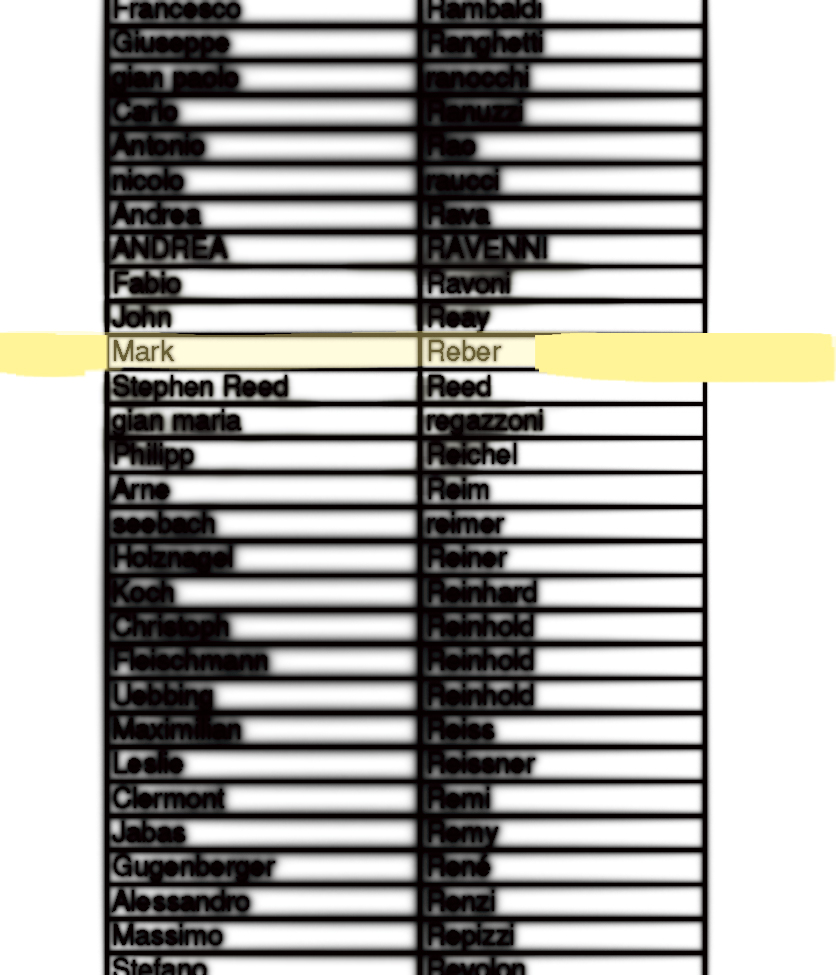
I noted in my earlier post, quite a while ago, that I had applied. That doesn’t make sense given the time stamp. But, no matter, I did apply and waited a month–and a few days–to learn the results. For better or worse, I am in and I am committed.

Mark makes the list

My name, among many others, mostly ending in vowels