Feeds:
Posts
Comments

A L’Eroica Training Log

Training and preparing for L’Eroica is not provided in some sort of online program or printed guide book. Perhaps the best advice I’ve read so far is not specific to L’Eroica, but to any demanding bike ride or race or physical activity. It is summed up handily in Rule 5 from the Velominati site.

Taking that as my guide, I am making a point now, just five weeks and a few days from the opening bell, to always go an extra few K on every ride. If I have a known route that connects to another, I combine them. If I have an existing route that can be extended, I do that. When the alarm goes off at 5:45 and I know I could use some more sleep, I get up and put the kit on.

This has been working well, but I wonder if it’s enough? I have yet to ride anything approaching a 205K distance. I know that I may not actually do so because training doesn’t necessarily require it. One significant element that I have yet to do much of is riding on the pebbles. The following link will show a route that I put together from a couple of others. It does include a 5K climb on gravel, though the surface is pretty forgiving.

A Portland Training Route

The roads and scenery around Trout Lake, Washington bring you within a few kilometers of  two significant Cascade volcanoes, Mt. Adams and Mt. St. Helens.

Mt. Adams by the USGS

With my son-in-law as ride-mate, we took on a loop ride from the Lower Falls Campground in Gifford Pinchot National Forest through Trout Lake and over the western flank of Mt. Adams. The ride includes some very quiet roads, breath taking scenery, steep ascents and equally enjoyable descents. For a map of the ride, go here: Lewis River-Trout Lake Loop.

On family camping trips, the Moseman tandem is usually the machine of choice. This time, my wife decided she didn’t want the punishment. I don’t blame her. She and I have ridden this loop before, albeit without the extra 33K of road between the loop and the camping. My original mapping of the ride had the distance pegged incorrectly and my son-in-law pointed this out before we set off. I wish he hadn’t said anything.

The weather on Saturday, August 6 was beautiful: sunny skies, temperatures in the low 70’s with a light breeze at our back when we started. We thought about that as we knew that the return would be into that same wind.

The first significant climbing occurs after you make the turn toward Trout Lake. The road is perfect, though, with just a few patches of gravel. The gradient is easily managed, even with the relatively high gearing that I cannot escape. We took just about two hours to get to the Trout Lake Ranger Station where we refueled with water and sandwiches and some excellent homemade cookies. Prior to that stop, though, I choked down my first experience with “Gu.” All I can say is that I hoped it helped me in some small way because the experience otherwise is not pleasant.

It’s not long after Trout Lake that you begin the climb of Mt. Adams. Here, the angle is more significant, with steep pitches that are followed by milder climbs and even some descents. The sun was on us, too, so we doffed the helmets and rode like hard men. Phillip was kind to me, letting me catch him as we made our way up the 20K or more of climbing.

Views to Mt. Adams are wonderful here and we had been teased with peeks at the western slopes as we made our way down to Trout Lake. After finally topping out, we rode the relatively flat, then steeply descending road to its junction with our return.

On average, the return is downhill, though there are some rollers that remind you that what looks easy on paper rarely is. Add to this the wind dimension, which at times was blowing quite hard in our faces. That meant crouching over the handlebars and creating the sore necks that we nursed with beers late in the day.

By the end, we had logged 116K of fantastic riding, averaging 23K/hour. As I made my final turn into the campground, I felt proud. Proud, that is, until I realized that to approximate L’Eroica’s long ride, I’d have to make the circuit all over again.

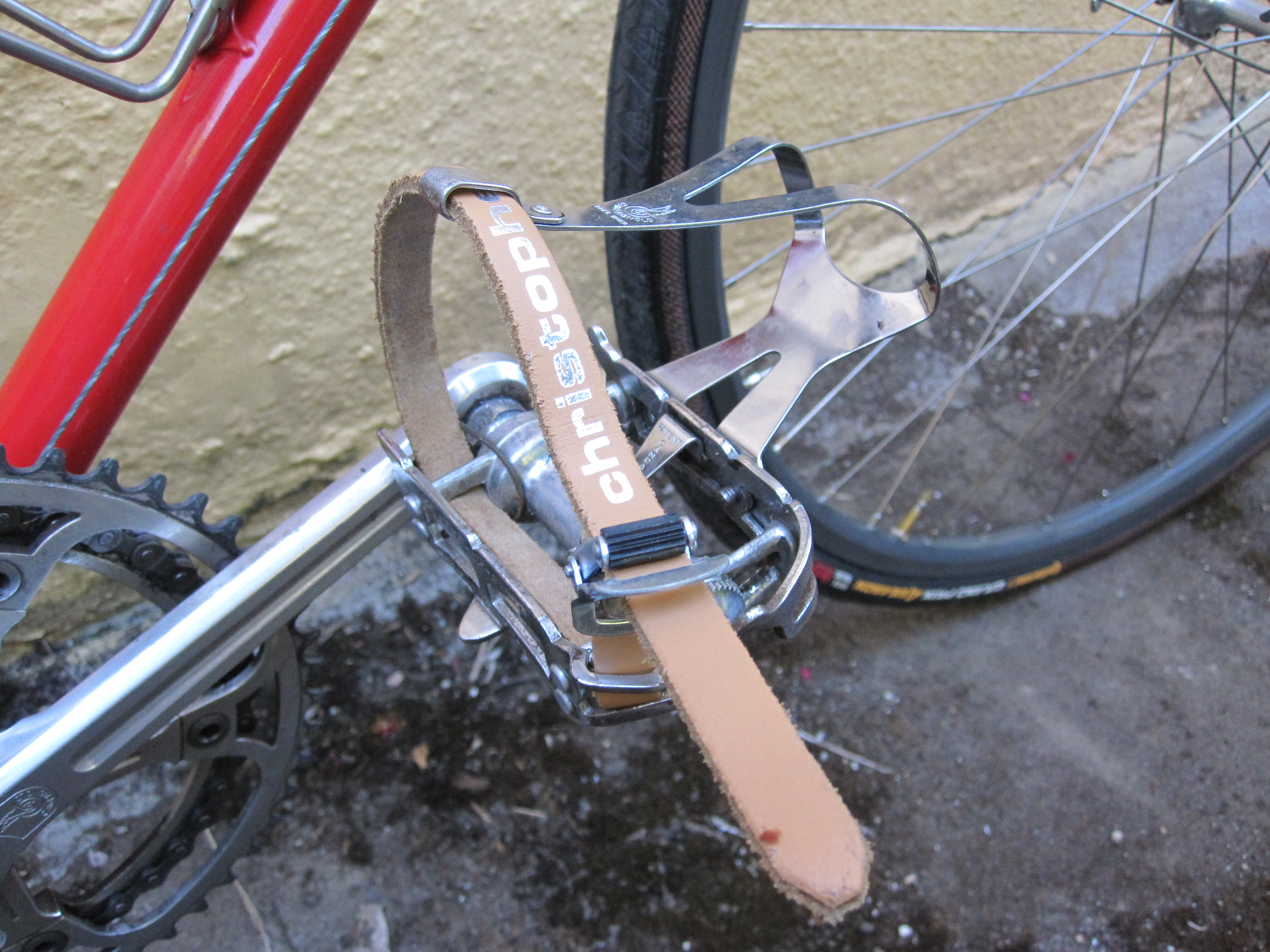
A waning skill among cyclists is the engaging and disengaging of a traditional cleat in a traditional pedal. With the wonders of the clipless pedal, we just snap our plastic molded, velcro strapped, ratcheting buckled shoes into place. Come to a stop sign or a place to dismount, twist and lift and we’re ready.

Enter the traditional pedal and the slotted cleat. You have to think about it and you have to be prepared to extricate yourself unless you want to be the laughing stock in front of the cafe or pub. It’s really quite simple, though. Just:

Drop—-Swipe—-Lift

At least for the removal. It’s good to have this muscle memory, especially when you’re riding along, enjoying the road and hoping that the rest of the route is downhill. Then, along comes a stop sign or a needed resting point and you’ve “forgotten” that your pedals are as pictured. You cannot use your foot alone to make the move. You have to free your foot from the rigors of the clip and strap. Or, fall down. It’s your choice.

This became clear in the month since I made the transition. It is reinforced every time I get on the bike. If you want to stay upright when stopped, memorize the action above.

Training and new pedals

My brother, who will join my wife and many members of my family to support my ride, ask me how the training was going. “Just fine,” I said, even if I haven’t ridden significant distances. I suppose I can say that with nearly three months of training time ahead of me. Or, can I? The longest ride I’ve taken so far, 60+KM from Sisters, Oregon to the McKenzie Pass and back, was wonderful and done on the tandem with Sue.

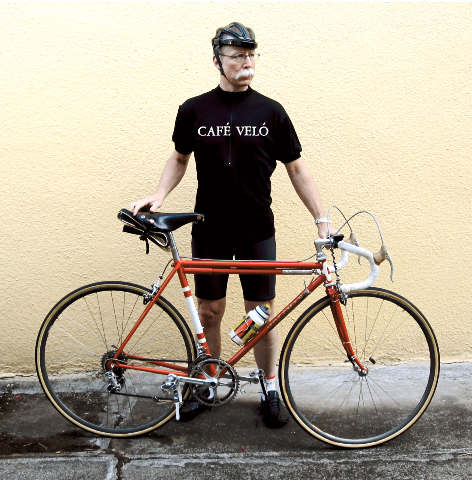
The Moseman and rider in the team kit

Even so, the climbing was constant and exhausting and I was glad when it was over. L’Eroica will be more than three times that distance, though the climbing may not be so difficult.

But, I keep at it even if it is at small increments. I’ve finished the conversion to “vintage” bicycle with the addition of the Campy pedals detailed previously. I even slapped on a pair of tubular wheels, even if they may be a bit more contemporary than the ones pictured on the various L’Eroica sites. And, what a pleasure to ride them. Fast, smooth and rolling like nothing else.

Here are a couple of gear pictures, which seem to be the ones that most readers, however few there may be, prefer.

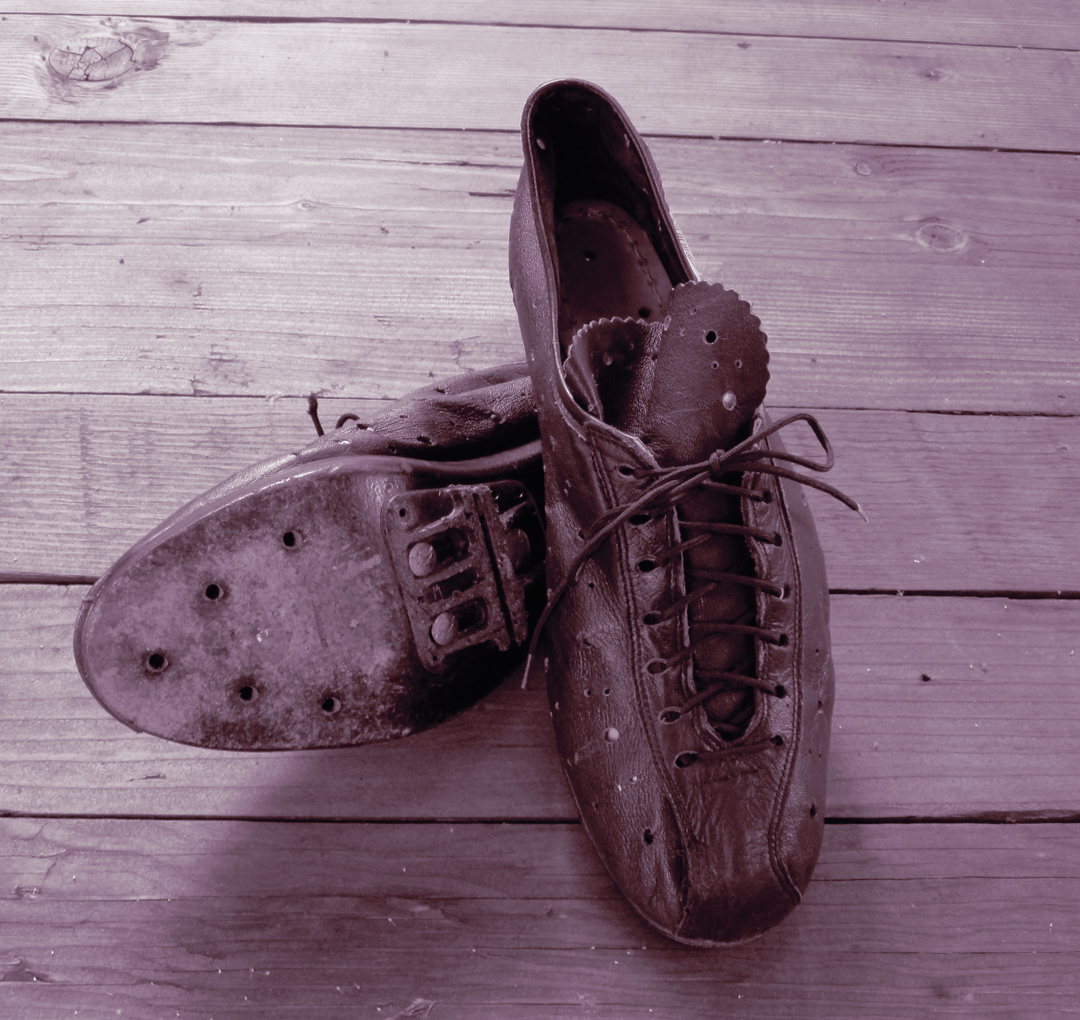
Shoes

The shoes, so far

This was the start of last weekend’s training session. I met Rick Wilson, owner of Cafe Velo, at his bricks-and-mortar version of the cafe at 05:00 on Saturday morning. The coffee trike has been making a splash in the Portland bicycle and coffee scene for a few years now. A Dutch bakfiet, it has been carefully and tastefully customized into a rolling coffee making machine. This was a Portland Farmer’s Market day and I was the lucky pilot who took her from her downtown parking spot uphill-all-the-way to the South Park Blocks. I spent the next couple of hours helping set up the cafe while Rick and I talked bicycles, fly fishing, chukkar hunting and fine European double-barrel shotguns.

The all-boy conversation ended with my wife’s arrival. We moved on to the finer things in life, including the excellent coffee that comes from this cart and the fine crepes that are made next door. This training ride was followed by a Sunday ride on the tandem with Sue, up and over the west hills via Saltzman, my touchstone for the local version of the strade bianchi.

20110629-125949.jpg

In this connected world of tweets, Facebook postings, and the like comes this article in the Guardian from a year back. I hope that it sums up the ride and experience well. Even though it makes careful note of the challenges of the strade bianchi, it confirms what a wonderful place that part of Tuscany will be in the early fall.

In case you don’t want to click through, I’m including this Vimeo piece from Le Coq Sportif, one of the main sponsors of the event. You may have seen it before, but it’s particularly good. There are two others in the series covering the first two days of L’Eroica, but this gives a good sense of the ride.

http://vimeo.com/15520631

With a bit of spare time and plenty of motivation–see my post on the spring classics book review–I tackled the job of returning the Moseman’s brakes to original form. If you’ve read any of the earlier posts or looked at the photo on the “The Bicycle” page, you’ll know that many years ago,

View of converted brake lever from handlebar side

I converted my Campagnolo Nuovo Record brake levers to something that approximated the Dura-Ace aero levers introduced in the mid-80’s. The pictures show the conversion work. The effort was misguided. At the time, it seemed important.

I’ve known for some time that the levers, and consequently the brakes, did not work as well in the conversion, but I didn’t care. They were cleaner without those exposed cables. Of course, the cable housing was still visible, so what had I really eliminated? A few inches of housing.

Pulley "fulcrum" on the converted lever

Today, after more than 20 years of the more modern look of an aerodynamic lever, the brakes are now returned to their original configuration. The levers themselves are an eBay find since I wasn’t sure whether or not I could salvage the old levers. As it turns out, it would have taken a bit of effort to return them to working order and they have been drilled through. Perhaps at another time, I’ll take them back to their origins. For now, the second-hand goods will do.

The test ride proved to me that the brakes work much better than the conversions. It was all I could do to keep myself on the bike on my first use. Makes me appreciate the quality of the brakes once again.

The cables, exposed.

And, now I can appreciate “the look” of the exposed cables. Original Campagnolo, by the way.

The readers here have told me, as clearly as possible, that I need to pay attention to my training and worry about tire selection another time. Really, the scientific and irrefutable evidence is on my previous post about tubular vs. clincher tires, all summed up in a poll. The poll is still open and I would be delighted if you could skew the results to something a bit more relaxing than training.

Yet, regardless of the advice, I am training and have been hitting the road and the trainer and the weight room. And, pushing myself away from the training table. Strong legs go much farther if they have less to push up the hill.

The training elements, early mornings in the gym, weekends on the road or short road rides after work, are beginning to take hold. I am breaking new barriers on the training machine and even the hilliest of rides is manageable.

The test of this preparation will come this weekend when I attempt either a long ride with my wife (and stoker) on the tandem or the more punishing ride up NW Saltzman on the Moseman. I may even try to get those brake levers returned to pre-aero condition, as if doing so might help me prepare for 2 October.

Lunch hour is over. Spare bits of chicken and salad with a few treats for a successful week of training. So as to leave you with something actually interesting on this page, I’ve linked to the new Rapha video by Nick Livesey. It’s over the top melodramatic, but it is Paris-Roubaix this weekend, which is nothing if not over the top.

A Throw of the Dice from RAPHA on Vimeo.

Training for L’Eroica is occupying much of my interests, or fears, these days. Though six months away, everything I can glean about the ride tells me that my legs and every other part of me must be ready for a long, difficult day in the saddle.

I’ve ridden centuries before. I’ve been put to the test on challenging climbs. My first significant one came in 1985 and was the excuse for my first visit to Europe. The Alpenbrevet went 160K over three mountain passes including one with 15K of cobblestones on the descent. (Current routes are different than when I rode it.) I also rode the 1988 Assault on Mt. Mitchell, a ridiculously difficult century ride that sounded good on paper, but was murderous. But, scores of kilometers of strade bianchi has me spooked. What to do?

Distract myself. That is really the reason behind the headline. You see it at the health club, you see it among snowboarders, you see it in riders cruising the bike paths around town. Everyone seems to be plugged in to their own personal noise machine.

We can always make the argument that music, whatever the genre or style, is motivating or soothing or inspirational. It may be and often is. What we really gain from these earbuds or headphones is a transport to some other place where the burning in the thighs and the labored breathing don’t exist. That’s for the world of old-school training.

Although my wife and I were hold outs for an iPod, the moment we got one, we used it primarily for our trips to the health club. It wasn’t long after that an iPhone was in my pocket and we the both could be plugged in. I created a playlist of rock and roll music that I thought would be sufficiently noisy and hard-driving enough to keep us going at high RPMs.

That playlist was played to death, but we never seemed to mind because it wasn’t really music we were enjoying. We were using the beats and the bass lines to drive our legs. Billy Idol might have been dancing with himself, but we were trying to dance on the pedals.

Then, by sheer accident or forgetfulness, I left the iPhone at home and had to go it alone. The Clash and The Stones were not there to help me. And, I posted just as good a training effort on the stationary bike as ever. That’s when I realized that the music was only a distraction, so why not have more variety in my distractions? How about a little opera to go along with “Sympathy for the Devil?” Why not let Beethoven’s 3rd Symphony, “Eroica,” help me visualize the roads of Tuscany, with the dappled sunlight and shining gravel?

And, that’s where I have ended up. I may put together other playlists including some with Billy Idol and The Clash. But, I’m just as likely to let Pandora do the work from Radio Opera.  Or, just as compelling would be entire symphonies, which often take us from slow warm up adagios to excited interval allegros and back to a warm down andante.

Depending upon how you count it, a bicycle and its rider are in contact at three crucial areas: the hands, the feet and the bum. Of the latter, it is more accurate to say the ischium because we don’t actually sit on a saddle as if it were a chair. In fact, it’s easy to identify those who know little about the bicycle when they refer to the saddle as a seat.

Those who know me, either personally or otherwise, know that I am a devotee of Brooks saddles, still made in their shop in the Midlands of England. I say saddles because there are many of them in many styles, but they have one thing in common: They are all made of real leather stretched over a frame. They are made as bicycle saddles have traditionally been made and they have all of those same advantages and drawbacks. They are rarely found on racing bicycles today, but are frequently seen on touring bikes, hipster fixies, bike messenger machines and are used more than any other saddle to identify a handmade bicycle frame as a top-of-the-market product.

I imagine that anyone thinking about vintage bikes ridden over the old roads would expect they were ridden on leather saddles. That’s what I’ll be doing. Regardless, I’ll readily admit that most other elements of the bicycle have been improved upon, particularly the components, since 1987, the latest year of construction for a bicycle to be entered in L’Eroica. Pedals, for one, are vastly improved. Many of the other components, though more complex mechanically, show the improvement that comes with greater research, competition and technological advances. But, not the saddle.

Sure, you can now buy and use a saddle that weighs almost nothing. It will be made of composites or plastics or even have padding with a leather cover. It just won’t possess the individualized comfort or the aesthetic of the all-leather saddle.

Apart from Brooks, who dominate the category, smaller producers are making leather saddles including some fine ones from Gilles Berthoud in France. Their weight may exceed, by many grams, those racing and touring saddles made of plastic, but they trade that weight for comfort and durability that cannot be matched. The Brooks Team Pro saddle on the Moseman is nearly as old as the bicycle and provides day-long comfort, not to mention a handsome, well-worn patina.